Submit a hubNashville request
Route potholes, missed trash, code concerns, and non-emergency service issues into one receipt-first path.
Pimp My Website experiment, civic flow edition
A task-first breakout page for Nashville.gov: search the service need, triage the intent, draft the hubNashville handoff, and keep news, events, maps, and recovery resources from competing with the first citizen job.
Demo boundary: based on the Nashville.gov homepage top-level flow observed May 14, 2026. No Nashville.gov links are followed from this page, and no demo form data leaves this browser.
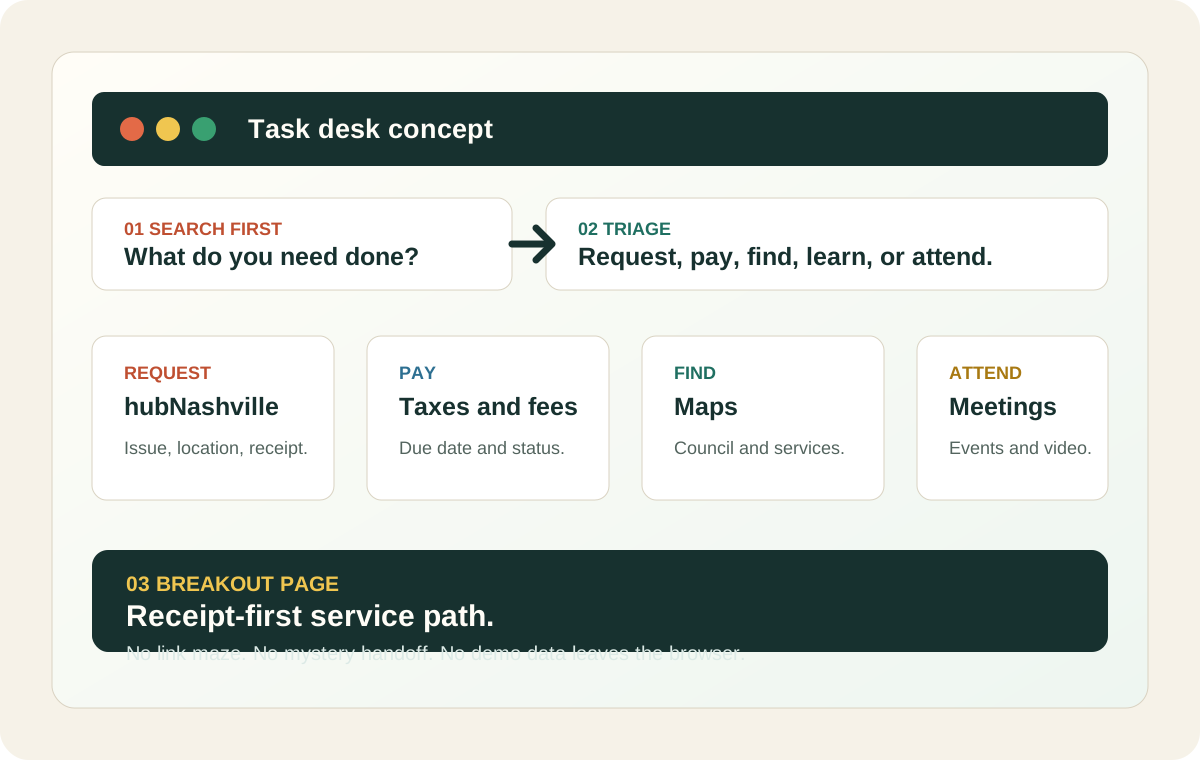
Prototype service desk
Current homepage signals include search, hubNashville requests, popular services, recovery resources, news, events, maps, district lookup, and Metro video. The improvement is not more content. It is a clearer first decision.
Route potholes, missed trash, code concerns, and non-emergency service issues into one receipt-first path.
Give users requirements, due dates, accepted payment types, and office ownership before payment.
Combine pickup schedules, drop-off locations, accepted materials, and service alerts in one branch.
Keep address lookup, council member, district boundaries, and public maps in one predictable path.
Promote restore and recovery resources only when urgent, with service status and office contacts.
Move civic awareness below the service desk unless the visitor chooses attend, watch, or learn.
Breakout page
This is the proposed breakout behavior: select the service intent, collect only the required fields, show a receipt, and keep the official handoff obvious.
Flow analysis
Pay, request, find, learn, attend, or watch. The page should sort the job before the department.
Emergency and recovery resources need priority lanes, not the same visual weight as general news.
Before a handoff, tell the user what address, ID, fee, photo, or contact detail is required.
Every request or service path should make ownership, status, and follow-up obvious.
News, events, maps, MNN, and feedback remain available after the service desk is solved.
What gets better
The resident picks a verb before scanning departments.
Requests end with reference language, not uncertainty.
Controls stay large enough for real phone use.
The prototype does not transmit user-entered data.
Usability and OWASP checks
Skip link, semantic headings, labelled form controls, button elements for commands, and an aria-live receipt panel.
Responsive single-column fallback, no horizontal overflow, stable tap targets, and service cards that do not resize unpredictably.
Search and receipt output use textContent, no eval, no inline event handlers, and no dynamic HTML injection.
The form has no network action. A production Metro form would still need server-side validation, rate limiting, CSRF protections, and abuse monitoring.
No external fonts, frameworks, trackers, or third-party scripts. The local SVG asset is served from the same static origin.
The deployment configuration keeps nosniff and referrer policy, and can add CSP, permissions policy, and frame protections without changing the demo flow.
Demo boundary
Ten Thirty Two is using the public homepage as a design-flow exercise. The page avoids official outbound links, does not collect real reports, and does not represent Metro Nashville. It demonstrates how a civic homepage could split search, service requests, recovery resources, news, events, maps, and video into a calmer resident-first path.